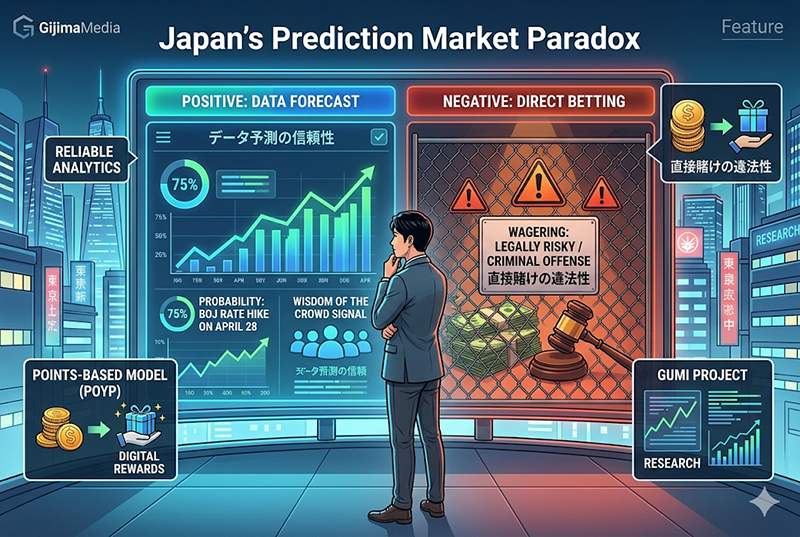
In 2026, Japan finds itself in a unique position where prediction market data has become a standard analytical tool for media and researchers, yet direct financial participation remains a legal gray zone. While platforms like Polymarket and Kalshi offer deep pools of liquidity on Japanese GDP, yen volatility, and political outcomes, the National Police Agency (NPA) continues to classify online wagering from within Japan as a criminal offense. For now, the Japanese market is evolving toward a “data-first” model, where the focus is on harvesting collective intelligence through points-based systems rather than direct cash betting.
How do Japanese residents access prediction market data in 2026?
Japanese users primarily interact with prediction markets as consumers of information rather than active traders. Major news outlets and digital publications now routinely embed live odds as “wisdom of the crowd” widgets to provide real-time probability estimates on events like Bank of Japan (BoJ) policy shifts or the price of regular unleaded gasoline. This allows the public to view market-implied probabilities, such as the 2026 prediction that the BoJ might raise interest rates on April 28, without ever opening a trading account.
In my years working in localization and gaming across Japan, the UK, and now Bulgaria, I have observed a distinct cultural appetite for high-quality data, provided it arrives through a trusted, compliant interface. Many Japanese readers now treat these market odds as a more reactive alternative to traditional polling. As my colleague Kana Makita recently noted, “The Japanese user isn’t necessarily looking to gamble on the news; they are looking for a signal that cuts through the noise of traditional pundits.”
Why is direct wagering on Polymarket still considered legally risky in Japan?
The core barrier is not a lack of technological interest but rather the rigid classification under Japan’s criminal gambling framework. Under Article 185 of the Penal Code, any activity that involves placing value on an uncertain outcome for the purpose of winning or losing property is generally prohibited unless specifically authorized by special laws (like horse racing or certain lotteries). Even if the operator is based overseas, the NPA maintains that connecting to and betting on these platforms from inside Japan is a crime.
Because prediction markets require staking money (often in the form of crypto-assets like USDC) on future events, they economically resemble gambling in the eyes of Japanese regulators. Unlike the United States, where companies like Kalshi have successfully argued that event contracts should be regulated as financial instruments, Japan currently lacks a dedicated regulatory “bucket” for retail prediction markets. Without being brought under the Financial Instruments and Exchange Act, these platforms remain on the wrong side of the NPA’s enforcement line.
Is there a compliant way to use prediction markets in Japan right now?
Yes, the market is currently seeing the rise of “sanitized” domestic cousins that decouple forecasting from direct cash wagering. Services like POYP have introduced a “prediction market × points-earning” structure where users receive reward coins for accurate forecasts. These coins can be exchanged for digital benefits like Eraberu Pay but are designed to stay outside the legal definition of gambling by avoiding direct cash equivalence.
Furthermore, major corporate players like gumi have begun studying the commercialization of “Predictive Data Services”. These projects aim to build fair, transparent, and compliant markets that use blockchain and AI to aggregate collective intelligence for sale to research institutions and media outlets. As Megumi Kato, a veteran in Japanese blockchain compliance, often says, “The value in Japan isn’t the bet; it’s the data generated by the bet.”
Comparing Prediction Market Models in Japan (2026)
| Feature | Polymarket / Kalshi (Global) | POYP (Domestic Japan) | gumi Project (In-Development) |
|---|---|---|---|
| Primary Settlement | Crypto (USDC) / USD | Digital Reward Points | Data-as-a-Service / Points |
| Legal Status in Japan | Legally Uncertain / Risky | Designed for Compliance | High Compliance Focus |
| Accessibility | Public View / Trading Restricted | Open to Japanese Residents | B2B / Partner Focused |
| Primary Use Case | Speculation & Hedging | Engagement & Rewards | Research & Intelligence |
The Evolution of Localized User Experiences
When I worked at Gamesys in the UK, my role was to bridge the gap between global standards and the exacting quality expected by Japanese users. In the context of prediction markets, this cultural sensitivity is paramount. A simple translation of a global platform is not enough; Japanese users expect a “native” feel that respects their specific UX preferences and regulatory environment.
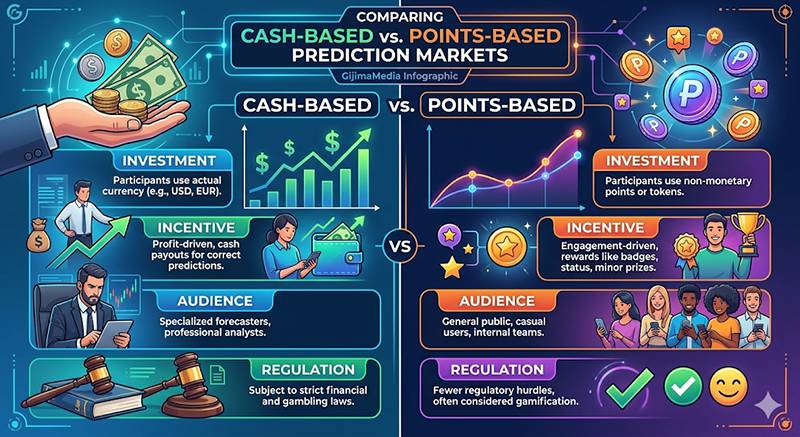
The success of the “points-based” model in Japan is no accident. It mirrors the historical precedent set by Pachinko, which uses an indirect system to separate the activity from direct cash payouts. By using a rewards-based layer, companies like POYP can satisfy the Japanese consumer’s desire for forecasting and social engagement while minimizing the risk of prosecution.
Risks and Ethical Limitations of Prediction Markets
While the “wisdom of the crowd” is a powerful tool, it is not without its controversies, which further complicates the path to legalization in Japan. In recent years, global platforms have faced scrutiny over:
- Insider Trading: The risk that participants with non-public information can exploit markets for disproportionate gain.
- Moral Hazard: Controversial contracts tied to military actions or “death markets” can create financial incentives for harmful outcomes.
- Market Integrity: The potential for manipulation in low-liquidity markets, which can distort the very “wisdom” they are supposed to provide.
For cautious Japanese regulators, these ethical “red flags” reinforce the tendency to categorize prediction markets alongside traditional gambling rather than as infrastructure for public interest. As I consult with development teams on products for the Japanese market, I always emphasize that trust is the most fragile currency in Japan; one ethical scandal could set the industry back by a decade.
Future Outlook: What to watch for in 2026 and beyond
The likely path forward for Japan is not the sudden legalization of open-wager clones of Polymarket. Instead, we should look for a “domesticated” evolution. Keep an eye on the following indicators:
- Regulatory Distinction: Watch if any Japanese ministry (such as METI or the FSA) begins to define “event contracts” as a distinct financial category.
- Corporate Pilots: Watch for gumi’s exploratory work to transition into live pilots with academic or media partners.
- The “Media Layer”: As prediction odds become a standard feature in digital journalism, the public may become “normalized” to this type of thinking long before the laws actually change.
Conclusion
As someone who has navigated the demanding corporate world of SoftBank and the specialized realm of international gaming marketing at GijimaMedia, I see prediction markets as more than just another crypto trend. They are sophisticated probability engines that, if properly localized and regulated, could offer immense value to Japanese society.
However, for the average resident in Hokkaido or Tokyo, the current message remains one of caution: enjoy the data, but stay away from the wagering until a clear, domestic framework is established.