Case Studies
The following case studies represent typical projects supported by Gijima Media. In some cases, client names and specific details are anonymized due to confidentiality agreements. Each example reflects real market challenges and realistic outcomes in Asian markets, particularly Japan.
Case Study 1
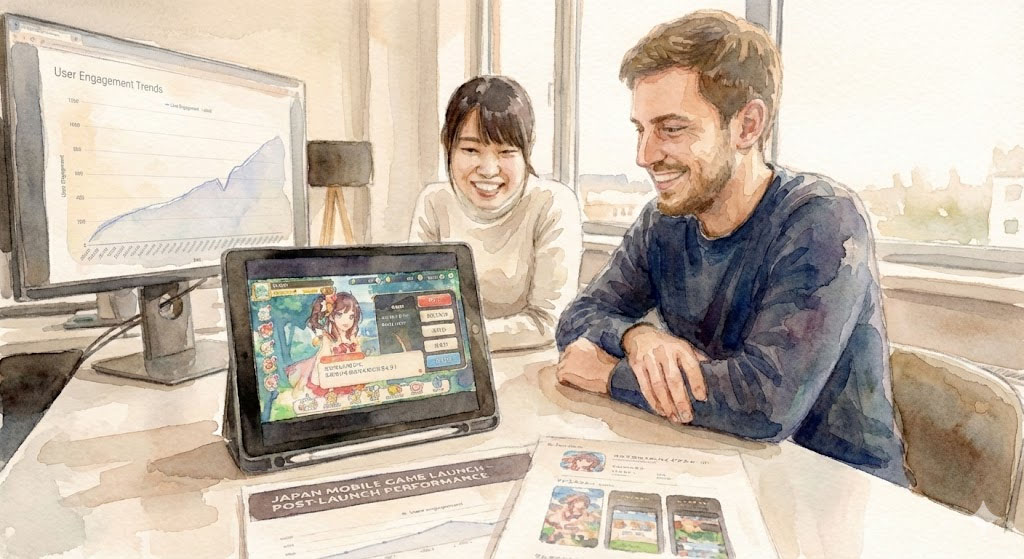
Mobile Game Launch in Japan
Client Profile
- Mid sized European game studio
- Mobile free to play title
- First entry into the Japanese market
Our Approach
We supported the project from the pre launch phase.
First, we reviewed all in game text, tutorials, system messages, and user interface elements. The focus was not only on language accuracy, but also on tone, clarity, and natural flow for Japanese players.
Next, we localized and restructured the app store page. This included rewriting descriptions, adjusting feature explanations, and aligning messaging with common expectations in the Japanese app ecosystem.
We also provided feedback on visual presentation and content hierarchy to improve readability and reduce cognitive load during first contact.
Challenge
The client planned a soft launch in Japan but faced uncertainty around localization quality and market readiness. While the game performed well in Western markets, early internal testing showed that Japanese users found parts of the interface unclear and the store page difficult to understand.
The development team was concerned that poor first impressions would damage long term performance in a trust sensitive market.
Outcome
The game launched in Japan with a clearer value proposition and more natural user experience. Early player feedback highlighted improved understanding of gameplay mechanics and onboarding flow.
The client was able to proceed with confidence into the next phase of marketing and live operations, having avoided common localization issues that often lead to early churn in Japan.
Case Study 2
Improving Retention for a Live Game in Japan

Client Profile
- International publisher
- Live service game with an existing Japanese user base
- Operating for over one year in Japan
Our Approach
We conducted a full review of user facing communication.
This included in game notifications, system messages, event descriptions, and customer support templates. We evaluated tone, politeness levels, clarity, and consistency across all touchpoints.
Based on this review, we proposed revisions focused on improving clarity and reducing friction. Special attention was given to event explanations, reward descriptions, and time limited mechanics, which often caused confusion among players.
We also provided guidance on internal localization workflows to prevent similar issues in future updates.
Challenge
The game had already launched in Japan but was experiencing declining engagement and increasing user complaints. Internal analysis suggested that while gameplay remained solid, communication with players felt inconsistent and occasionally confusing.
The publisher suspected that localization quality and tone might be contributing to lower trust and retention, especially among long term users.
Outcome
After implementing the revised content, the client reported fewer user complaints related to misunderstanding game systems and events. Player communication became more consistent and easier to follow.
While gameplay mechanics remained unchanged, improved clarity contributed to stronger player confidence and smoother ongoing operations in the Japanese market.
Case Study 3
Market Entry Planning for Asia

Client Profile
- Game publisher based outside Asia
- Portfolio of multiple titles
- Considering expansion into Japan, Korea, and Southeast Asia
Our Approach
We supported the client with structured market entry planning.
First, we assessed each target market based on genre fit, platform trends, competitive landscape, and localization requirements. We identified key differences in player behavior, monetization expectations, and trust dynamics across regions.
Based on this analysis, we recommended a phased entry strategy. This included prioritizing specific markets, defining localized positioning, and outlining practical next steps for localization and marketing execution.
We also provided guidance on internal resource allocation and realistic timelines.
Challenge
The client initially planned to launch simultaneously across several Asian markets. However, internal teams lacked clear insight into which markets should be prioritized and how strategies should differ by region.
There was concern that a broad launch approach would stretch resources and reduce effectiveness.
Outcome
The client adjusted their expansion plan to focus on fewer markets initially, with a clearer understanding of risks and requirements.
This approach allowed the publisher to allocate budget and team resources more efficiently and prepare localized assets with higher quality, rather than spreading efforts too thin across regions.
Our Role Across Projects
Across all projects, Gijima Media acts as a strategic and execution partner. Our focus is on reducing uncertainty, improving cultural alignment, and supporting long term success in Asian markets.
We work closely with internal teams and adapt our involvement based on the stage of the project, from early planning to live operations.
Talk to Our Team
If you are planning to localize your game for Asia or improve existing localization, we are happy to review your current setup and recommend next steps.